Advertisement

Advertisement
Advertisement
Advertisement
Advertisement
Advertisement
Advertisement
HISTORY
science fiction
in focus
By Will Street
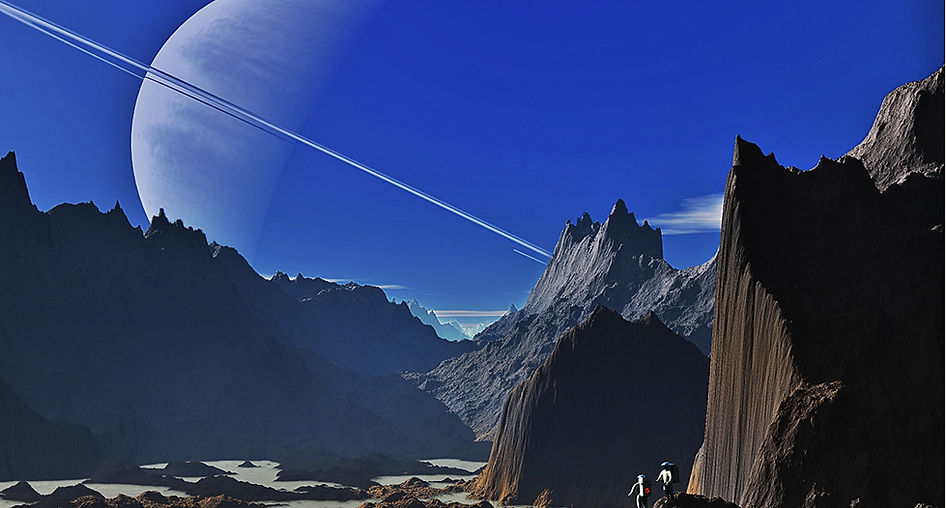
The famous novelist, H.G Wells, proclaimed in the early 20th Century that “looking at these stars suddenly dwarfed my own troubles and all the gravities of terrestrial life.” H.G Wells was a famous exponent of literary Science Fiction and it is clear from the quotation that the direction of Wells’ inspection is the overarching science of the universe he is viewing. However, it appears and what becomes apparent through his literature is that Wells can only and crucially offers speculation regarding the scientific phenomena he is observing. And it is this “speculation”, in fact, that forms the basis of much of Science Fiction literature. What Science Fiction writers are most commonly occupied with is offering a development of fictional environments that are “speculation”, yet at their crux, normally relate to scientific phenomena. The “speculation” underpins their “fantastical” nature – a nature that defines the genre.
How the literature is constructed and constructed around science normally involves a basis on theoretical scientific principles and can commonly implement futuristic elements that are grounded in scientific theories, such as technology, space exploration or futuristic ideas that are inspired by modern thought. It essentially an exposition of “fantasy”, but crucially through a scientific lens.
But, having established that the genre is simply a variation of human thought, it therefore follows that the style of “Science Fiction” appears in some of the earliest writings of our society. Even the ancients could imagine and suppose supernatural ideas. Having said that, before we embark on our assessment of “Science Fiction”, I believe it is necessary to set parameters over what we class as “Science Fiction” and what we do not. Homer’s “The Odyssey” is a prime example and a useful case study.
The tales of “The Odyssey”, with their description of fantastical beasts, or, alternatively, the battering down of the storms are certainly fantastical. However, what this would pertain to would be biology and meteorology. These were scientific disciplines the Ancient Greeks certainly had no knowledge of. They are not speculating their own scientific knowledge upon a fantastical world. In a similar way to “The Odyssey”, this determination over what constitutes “Science Fiction” immediately, therefore, rules out great swathes of ancient literature.
However, someone who could assess a subject and speculate upon it through his own scientific lens was Plato. One of the greatest and well-known ideas of “Science Fiction” was Plato’s “Republic”. Our definition of “The State” is an object of political science in itself. It is an act of science that can be imagined, idealised and viewed in the context of the future. It was the very work of “Science Fiction” much later – George Orwell’s “Animal Farm” that underscored the fantastical potential of political science.
Within Plato’s “Republic”, the philosopher famously set forth his allegory of a cave. The object of the cave was to illustrate that humans are only living in an “illusion” of the world. Where its relation to “Science Fiction” appears is in the proclamation of a pursuit of wisdom and political structure – both of which act as elements of science.
Taking a closer look at “The Republic”, there are various instances where apparent scientific knowledge is used as a basis for fantastical depictions. The allegory of the caves revolves around a range of elements. A group of young friends are stood in the cave, stood in fact for their entire life, chained to the stone and unmoveable. They are stood facing the walls and incapable of seeing anything else. Yet further, behind the incarcerated men is a perpetual fire. The fire shines a light across the prisoners, painting an image of shadows onto their wall. The fire shines a light not only upon the prisoners, but also congregations of people carrying models of animals and other entities. Only being able to view the shadows, the young men believe there is a world, but, in accordance with the shadows, it is only meagre and one-dimensional.
However, eventually one of the prisoners is liberated by a man who entered the cave. The freedman turns around and witnesses the exit to the cave that had been behind him. But here another twist unfolds. Rather than being comfortably liberated, the bright light of “reality” is too much for him to bear and he is “dazzled”. Learning from his mistakes, the other conglomeration take attempts to view the light slower and gentler. Eventually, the remaining crowd succeed in viewing the light beyond safely and freely.
The light of the sun, reflecting the light of the day and the dark of the night, immediately demarcates this exponent of “Science Fiction”. It also ties into “Political Science” (How can we as humans better our society), a subject that is studied in more depth in other parts of “The Republic”.
The most crucial of these are Plato’s comments on “The Ideal State”. As a flourishing feature of “Political Science” in itself, Plato set forth three types of government – all of which he regards as failures. These are “timarchy”, “oligarchy” and “tyranny”. This empirical nature of studying governments is a clear feature of science – a call for us to regard how these entities can be understood by formal definition.
Acting as the prevailing feature of Athenian society, what Plato also goes into further discussion about is the leading structure of the day in opposition to his own utopia. This was “democracy” in contrast to Plato’s notion of “philosopher kings”. “Democracy” is too complicated, he says, and cannot deal with complex issues such as foreign policy or economics. He also said that Athenian leader gained power by telling voters what they wanted to hear, when they should have been charting a plan for the health of the state. Plato proclaimed that the result was “a pleasing, lawless, various sort of government, distributing equality to equals and unequals alike.”
The superior alternative, Plato argued, was his concept of “philosopher kings”. This was a highly meritocratic schema, in which the state would be governed by an elite body of philosophers who aimed solely for the wellbeing of their country. Their meritocratic nature was constantly emphasised. They should be, Plato envisaged, highly educated, spiritually developed and incorruptible at the core. In fact, Plato said that the governors would be those who had returned from their state of philosophical serenity to do, in effect, a favour to the state by dropping their isolation and leading the state, instead, to salvation.
Plato’s “The Republic” is highly famous and has been continually studied and applauded since its genesis in 4th Century BC Athens. “Science Fiction” as a genre continues to permeate later literature once again in the form of “Political Science”. Searching for scientific evidence in this mass of early literature, the unfortunate outcome we find ourselves with is that entity is mostly the “political” to grapple with. We are, in effect, tracing and examining societies where scientific understanding was very little or none.
In Tudor England, many years later, a high-ranking officer and literary canon was found in the form of Thomas More. He was a fervent religious character. He was someone of high social status and at one point leading tutor to the young Henry VIII. This famous monarch reigned from 1509 until his death in 1547. Thomas More’s most acclaimed publication, “Utopia”, was released in 1516. It was written in Latin and, at its crux, was a political satire idealizing a supernatural island.
Essentially the creation foretold of a fictional society that contrasts and criticises contemporary European politics. In effect, it envisages a rational and equitable social order instead. In fact, it was the first literary compilation that coined the term “Utopia”. Such a term would be used and referred to extensively in later literature. Such a term, in fact, needs analysis as it illustrates and demarcates “fantasy” – both during More’s era or throughout later literature. The term “Utopia” is derived from the Greek “ou” (not) and “topos” (world). In its literal sense, therefore, “Utopia” means “nowhere”. It follows that every work of “Utopia” is essentially “fanstasy”.
Assessing More’s masterpiece, some of the most foundational themes include social justice, communal property, religious tolerance and rational governance. These are expressed through depictions of a state that has no private property and provides free education to men and women. The text also established labour and consumption as entities that should depend on each citizen’s abilities and needs. In effect, More’s schema is a highly socialist formation, and sets out a dream of something more blissful compared to the English society he observes around him. More’s initiation of the so-called genre of “Utopia” would pervade later works of literature extensively. By post WWII Britain, “Utopia” was any kind of fantastical envisagement. With so many visions of “Utopia” abounding through literature, the 16th Century origin – Utopia – could be used as a motif to anyone embarking on writing “Science Fiction”.
However, a society that envisaged “fantastical” elements at a very early stage were the writers of “Beowulf”. This was a famous corpus that appeared in English literature during the Dark Ages. It was written in Old English. The text, which has survived, manifests inspiration both from German heroic legends and even biblical writings. Specifically, it is mostly written in the West Saxon dialect of Old English. The reason why this text is relevant to “Science Fiction” lies its depiction of monstrous beasts and animals. This would define it, therefore, as an example of “Veterinary Science Fiction”.
Crucially, Hrothgar is plagued by a monster called Grendel. It is against this beast that the protagonist, Beowulf, is primarily summoned for. It is the beast that Beowulf kills with his bare hands. Later in the tale, Beowulf becomes the king of his homeland. However, he is then beset by a dragon, who terrorises his realm. In both instances, therefore, the entity of fantastical beasts is at the forefront. These fantastical beasts were based on what contemporary citizens observed around them. The very title of the poem “Beowulf” immediately draws relevance to the fearsome wolves that villagers would have encountered in the wild. To this we can add further “bears”, “eagles” and even wild hogs. The writers of “Beowulf” are thus transferring a scientific knowledge of wildlife into a more dramatic and fantastical set of beasts. It is a speculation into how great a beast can be based on their pre-existing study of concurrent wildlife.
The imaginative tale of “Beowulf” was written at some point during the Dark Ages. The first manuscript of the text was produced between 975 and 1025 AD. It is an impressive article of something that, at such an early date, sought to broach the unknown and attempt to envisage how superior wild beasts could ever become. It demonstrates a search for scientific wisdom, something that comes to the forefront many years later during “The Enlightenment”.
At the beginnings of the “The Enlightenment” scientific understanding begins to usurp the pre-existing Church’s narratives. Arthur Koestler in his book, “The Sleepwalkers: A History of Man’s Changing Vision of the Universe”, proclaims that “with the publication of Newton’s “Principia” in AD 1687, cosmology became a disciplined science.” As we would expect, English literature approaching this material would soon develop. It was a literary explosion that was regarded as returning intellectualism to the glories of antiquity.
A central production from this “age of reason” was Jonathon Swift’s “Gulliver’s Travels” (1726). This was essentially contained elements of alien culture and bizarre aspects of science. It was crucially an exhibition of extra-terrestrial life. Precisely, the protagonist of the tale, a one Lemuel Gulliver, travels to a series of strange and distant lands. Each location is inhabited by unusual beings. Fitting into its genre of “Science Fiction”, the islands and the populace reflect aspects of Swift’s contemporary 18th Century society.
Swift’s literature is one of the first instances in which we encounter the theme of “alien life”. This is one of the most fundamental features of what we regard as “Science Fiction” today – something that equally permeates film and literature up to the present hour. What we begin to see as scientific understanding develops further and increasing amounts literature caress the genre is an eventual “Golden Age” of “Science Fiction” literature in the 19th Century. This is where literary titans appear, tropes and motifs that are sustained even amongst the blockbuster films of 21st Century Hollywood.
Nothing is arguably more famous than Mary Shelley’s “Frankenstein” (1818) or Bram Stoker’s “Dracula” (1897). Both preach about the development of supernatural beings. Shelley’s “Frankenstein” perhaps evokes a greater scientific understanding in the medical creation of a supernatural beings, however Stoker’s “Dracula”, albeit gothic, has an extensive focus on the supernatural potential of bats. They both depict a fantastical world, yet once again, are reliant upon scientific ideas to expound their dream-like worlds.
Before long, the advanced societies of 20th Century Britain, the US and Europe would clamour for, in effect, an explosion of “Science Fiction” media. One of the emphatic features of this drive was the emergence of the “Comic Book”. The first comic book under the DC banner was published in 1937. Before long one of the most highly acclaimed series of “Science Fiction” was written in 1965. This was Frank Herbert’s “Dune” (1965). Herbert created a franchise that emanated from his vison of a desert planet. Ultimately, his works were acclaimed for their insight into the relationship between personalities at the forefront and then their connection to religious and economic power. This, alongside, Herbert’s fundamental concoction of such a vivid environment has cemented the corpus as one of English Literature’s all-time greats.
As we emerge into the late 20th Century and 21st Century, we arrive at a point where pretty much all cosmological, biological, physical and all other science is understood. Therefore, a writer has before them the whole block of material before they embark on a “Science Fiction” novel. As a result, we find before us today a wide diaspora of “Science Fiction” novels and their differing tropes. It is a wide eclectic mix that reflects the breath of human thought. This is perhaps best reflected in the emergence of “Cyberpunk” in the 1980s. Society and human thought had become so liberal that science could be enjoyed and used to attach emotion. At its end point, it stood as proof that scientific knowledge would entrance students even now as it has done throughout the preceding centuries.