Advertisement

Advertisement
Advertisement
Advertisement
Advertisement
Advertisement
Advertisement
HISTORY
A Brief Overview of Hinduism
The third most popular religion in the world, and one of the oldest, Hinduism has been central to Indian society and culture for thousands of years.
By Will Street
Jul. 25, 2019, 11:30 AM

RELATED
Origins
Hinduism is often referred to as Sanātana Dharma, meaning "eternal religion". This name refers to the the idea that Hinduism's origins are beyond human history, but rather its truths have been divinely revealed (shruti) and passed down to subsequent generations from the most ancient scriptures, the Veda.
Another view concerning the origins of Hinduism is centred around the idea that divine truth was revealed to the Aryans, who were a group of people that lived in India thousands of years ago. The Aryans shared the same language as the Veda, Sanskrit, which is one point supporting that claim.
Historically, some, in particular Hindu nationalists, believe that the Aryan peoples were native to India, however others, such as western scholars, argue that the Aryan peoples were not native, but rather incoming invaders who conquered regions and imposed their ideology on new communities. According a large portion of western scholars, the Aryan migration into India is dated to around 1500 BCE, while the Rig Veda, the earliest known scripture of the Aryans, to the centuries that followed.
In short, there is no agreed account as to the origins of Hinduism. From the mid 19th Century onwards, British and Indian archaeologists have uncovered the remains of several early cities in the Indus Valley region of the Indian subcontinent, which have been dated to 2600 - 1800 BCE. The archaeological evidence found is inconclusive, although there are some faint reminisces of modern day Hinduism. One seal found shows a seated horned figure surrounded by animals, which could be an early depiction of Shiva. There are also many female figurines, which could be a sign of goddess worship that has continued to the present day. There is debate also about whether the Indus script found is a relative of Sanskrit, and thus a connection to the Aryan people, or whether it is a Dravidian language of a native indigenous people.
Much of the world's understanding of Hinduism's early history is coloured by the British Empire's needs in governing India in the 19th and 20th Centuries, but also by the teachings and literature of modern day Hinduism that puts forward its own views of the origins of the religion. However, it is on an ongoing field of research in contemporary scholarship.

Sacred Texts
Hinduism's religious scriptures are divided between Shruti, which means "revealed", and Smriti, which means "remembered" or "handed down". Shruti refers to the early texts that were revealed to the early sages or rishis by the divine and are considered the word of the divine, whereas Smriti literature is the word of humans.
The Shruti scriptures are commonly dated to between 1500 and 300 BCE and all were written in Sanskrit. The earliest composition of Shruti literature were the Veda, which consisted of the Rig Veda, Sama Veda, Yajur Veda and the Atharva Veda. The first three of the Veda contain hymns and mantras while the fourth, the Atharva Veda, contains spells and charms.
There are three other collections of Shruti literature, which were the Brahmanas, the Aranyakas and the Upanishads. The Brahmanas contained instructions on rituals, the Aranyakas, which were a later development on the Brahmanas, detailed information on secred rites and philosophical speculation, and the Upanishads, which translates as "sitting near", were formulated as a sage teaching secret scriptures to his disciple.
The Upanishads spoke of spiritual nature such as that one's self, atman, is the life force within both the world and humanity, brahman (6.13). The teachings in the Upanishads on ultimate reality became central within the philosophical system of vedanta. Vedanta was one of six orthodox systems (darshana) within Hinduism, which revolved around understanding ultimate reality and self to be identical (Shankara), and also separated (Madhva).
The Smriti literature is comprised of the epics, Sutras and Puranas. Within the epics segment is the Mahabharata, which includes the Bhagavad Gita, and the Ramayana, both dated to between 500 BCE and 100 CE.
The Mahabharata is an epic poem that sets forth the tale in which two families of cousins, the Pandavas and the Kauravas, are battling for sovereignty against each other in the Kurukshetra War. The poem first appeared in its present form in 400 CE and at almost 100,000 couplets, it is twice the size of the Iliad and the Odyssey combined. The Mahabharata was being formed at a time when India was in transition from Vedic sacrifice to sectarian Hinduism, along with interactions between Hinduism and Buddhism and Jainism, which is reflected in the varying beliefs expressed in the Mahabharata.
Within the Mahabharata is book 6, the Bhagavad Gita, which is a dialogue between Prince Arjuna, on the side of the Pandavas, who is about to face Kauravas in battle. Krishna persuades Arjuna that one can only kill the body but the soul is immortal and transmigrates to a different body after death. He lists the cycle of death and rebirth, samsāra, and that only someone who has understood the true teachings can achieve liberation (moksha) or extinction (nirvana).
Krishna also sets forward a new philosophy that resolves the dichotomy between the Vedic scriptures that states a follower should sacrifice and attain good karma, and the theory of the Upanishads to meditate and amass knowledge (jnana), arguing that one must perform Bhakti yoga, - performing one's duty for its purpose alone. The Bhagavad Gita is also important in Vaishnavist theology, positing Krishna as an avatar of Vishnu.
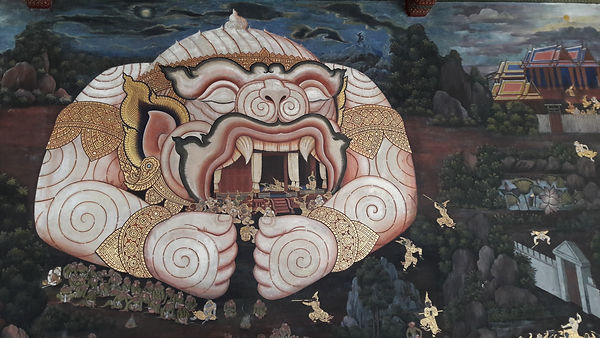
The Ramayana was written between 500 BCE and 100 CE, and similarly was an epic poem that narrated an episode in the life of a great warrior. In the case of the Ramayana, the protagonist, Rama, is banished from the Kingdom of Ayodhya as a prince, following a palace intrigue. He takes his wife, Sita, whose marriage Rama had won by bending the bow of Shiva at a bridegroom tournament, and his favourite half-brother, Lakshmana, into exile as well. However, in exile Sita is captured by the demon-king, Ravana, and taken away to his capital in Lanka. With the assistance of the monkey-general, Hanuman, and Ravana's own brother, Vibhishana, Rama attacks Lanka, and slays Ravana. He rescues Sita and she walks through fire, proving her chastity. Although perhaps one of the less virtuous morals to a story considering something like that should not be repeated in real life, it is a sign in the Ramayana of her unwavering loyalty to her husband throughout her time in Lanka.
The Ramayana is supposed to teach about the importance of dharma. Rama is presented as exemplary in correspondence to his respective duty, obediently accepting his banishment from Ayodhya, and his decision to banish Sita at the end is a sign in the Ramayana of his obedience to his duty to rule over his subjects in Ayodhya first and foremost. Hanuman and Lakshmana's loyalty also reflects their duty to serve the King, while Sita's chastity is a sign in the Ramayana of her following her duty as a wife.
The Ramayana has been much retold in film adaptations, including Nina Paley's 2008 animation, Sita Sings the Blues, which takes a more modern approach to the tale and one more sympathetic to Sita. Rama has also been hailed as a divine ruler of the longed-for Hindu state by Hindu nationalists and conflict has arisen such as in North India in 1992 where Hindus destroyed the Babri mosque, claiming it was built on the site of a more ancient temple marking the birthplace of Rama.
In the same period as the Ramayana, the Sutras were composed, which were a number of texts about subjects such as dharma, yoga and vedanta. One of the most important texts from this period was the Manusmriti, which dealt with Hindu law and conduct. Later, from 300 to 900 CE, the Puranas were compiled, which were mythological texts that referred to earlier events, often telling the stories of the gods and goddesses.
Gods and Goddesses
Hindus believe that there is one transcendent God, but also many gods. It is therefore best described as the many and the one. In the Brihadaranyaka Upanishad, a seeker asks the sage Yajnavalkya how many gods there are, to which he is told that there are three thousand and also one. The three primordial deities, Brahma, Vishnu and Shiva are each considered the transcendent Lord, however they and a multitude of lesser deities also exist, that are either avatars, representations or in some way related to them.
The three principle deities of Hinduism are Shiva, Vishnu and Brahma. Shiva is the destroyer god, either of evil or life, Vishnu is the "preserver" god, and Brahma is the "creator" god.
From the time of the later Upanishads, Vishnu and Shiva became popular deities and cultic practices and doctrinal teachings evolved. In their stories or "myths", recorded in the Puranas, Shiva and Vishnu were described iconographically for the first time. Shiva was depicted as a Himalayan ascetic while Vishnu as a blue youth holding in his four hands a discus, mace, conch and lotus. Brahma is traditionally depicted with four faces and four arms. His hands hold symbols of knowledge and creation, including the Vedas and rosary beads symbolising time. The gods manifest their presence in the world at certain times. For instance, Vishnu asserted his influence by taking animal or human form in periods of darkness and moral degradation. By the end of the Puranic period, in around 900 CE, ten principal incarnations of the god Vishnu had been recorded.
Other important deities in Hinduism are Krishna and Rama, who are to a certain degree described as incarnations of the god Vishnu, but are also seen as independent deities, supreme in their own right. Rama is depicted as a warrior with bows and arrows, but also in connection with the characters in the Ramayana - escorted by his wife Sita, brother Lakshmana and devoted servant, Hanuman, the monkey warrior - while Krishna is most commonly shown as a young flute-playing cowherd boy, either surrounded by cows, playing with friends or teasing the cowherd girls (gopis).
Hindu goddesses include most notably Lakshmi, Parvati and Saraswathi. Lakshmi is the goddess of wealth and wife of Vishnu, Parvati is representation of Shakti which is "sacred force" or "energy", the goddess of the household and motherhood and wife of Shiva, while Saraswathi is the goddess knowledge, music and the creative arts and wife of Brahma.
Another important god, very popular among Hindus, is Ganesha, who elephant-headed deity, revered by Hindus for his kind attention to the requests of his devotees and ability to remove obstacles. He is generally offered a rotund in worship, as a lover of sweets.
Festivals
There are roughly 12 major festivals in Hinduism. One of the most popular and famous is Divali - the festival of lights. Lasting several days in October or November, it is diversely associated with the gods Rama and Krishna, and the goddess Lakshmi. During the festival,small lamps are lit and presents are often given.
In March, there is the festival of Holi, which is often associated with the defeat of the demoness called Holika. During the festival, coloured powders or paints are often thrown in a spirit of joy and mischief. In February or March, the Shivaratri festival takes place, which is the principal festival for Shaiva Hindus, when offerings are made to Shiva and his praises are sung. In September or October there is the festival of Dashera or Dussehra, which is the "tenth" night following the festival of Navaratri when Rama's victory over Ravana is celebrated.
Other festivals include Makar Sankranti in January and Ramnavmi in April.

Beliefs and Tenets
Hinduism has no founder or prophet, but rather developed out of Brahminism. Hindus believe that there is one God, Brahman, which is eternal force in the universe, and all other gods are a representation of that force. They also believe that Brahman exists inside the body, as the atman or "soul".
The religion also holds that there is a cycle of death and rebirth, called samsara, and that someone can attain good karma in order to reach liberation from samsara (moksha).
In pursuing dharma, or religious practices, in order to attain good karma, there are different paths a Hindu can take. These are Jnana yoga (the path of knowledge), Dhyana yoga (the path of meditation), Bhakti yoga (the path of devotion) or the karma yoga (the path of good actions).
Although increasingly downplayed owing to discrimination problems, Hinduism divides society into the caste system - the brahmin caste (philosophers and teachers), the kshatriya caste (rulers and warriors), the vaishya caste (tradespeople) and the shudra caste (servants). There is also a caste below, called the untouchables or Dalit caste, which were a group of people thought to be low on karma owing to their previous life.
Hindus actively engage in worship of the divine, called puja, and, in funeral services, deceased Hindus are cremated. They also actively pursue varied pilgrimages.